
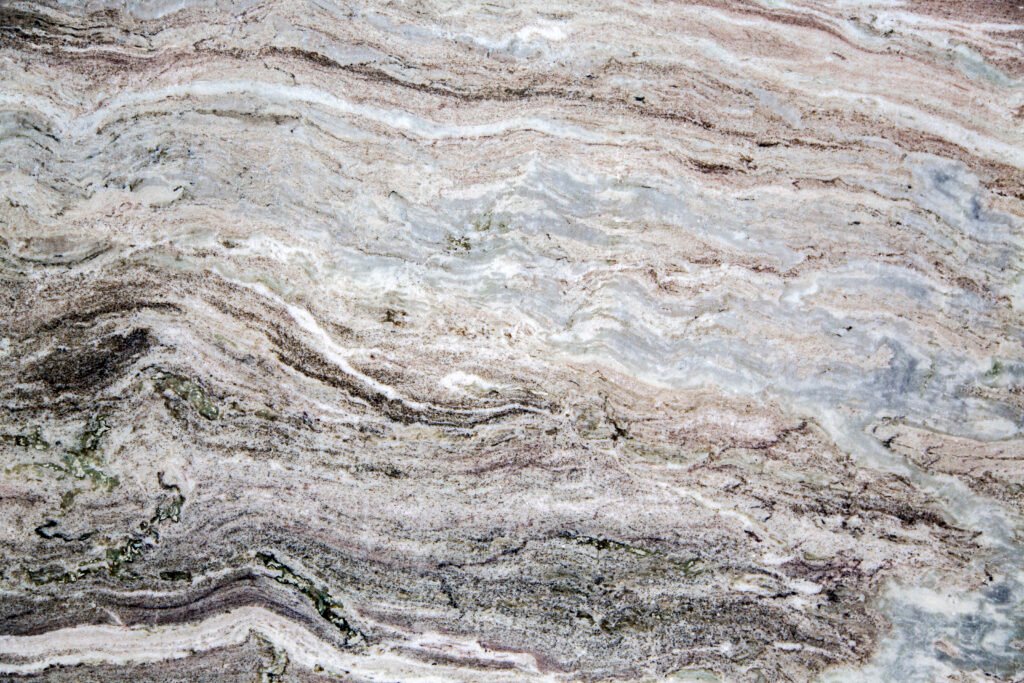
What Is Quartzite?
Quartzite is a fully natural stone, formed when sandstone rich in quartz crystals is subjected to intense heat and pressure deep within the earth over millions of years. That metamorphic process fuses the quartz grains together into an exceptionally hard, dense stone prized for centuries for its durability and its striking, marble-like veining.
For homeowners who love the soft, flowing movement of natural marble but want a surface built for daily kitchen life, quartzite is often the answer: it delivers that same organic beauty with dramatically better resistance to scratching, heat, and everyday wear.
Quartzite vs. Quartz: Know the Difference
The names sound alike, but they’re not the same material. Quartzite is quarried from the earth, every slab is one of a kind, shaped entirely by nature. Quartz countertops, by contrast, are engineered: manufactured mostly from ground quartz crystals bound with resins and pigments to create a consistent, repeatable pattern. Both are excellent, durable choices, the right one depends on whether you want the singular character of a natural stone or the uniformity of an engineered surface.
Key Characteristics
Pros: Exceptional hardness and durability, often harder than granite. Excellent heat resistance for areas near stovetops and ovens. High scratch resistance for busy kitchens and daily food prep. Natural, one of a kind veining and movement, no two slabs are identical. A luxury aesthetic that closely resembles marble, with far greater everyday durability.
Cons: More porous than engineered quartz, so it requires regular sealing to resist stains. Typically a premium investment, priced above granite and comparable to high end marble. Slab to slab color and veining can vary, so in person selection is recommended. Fabrication requires specialized tools and experience, given the stone’s hardness.
Maintenance and Sealing: Seal new quartzite countertops immediately after installation, then reseal annually or as recommended by your fabricator. Clean daily with warm water and a mild, pH neutral soap, avoid acidic cleaners and abrasive pads. Wipe up spills from wine, coffee, and oil promptly to prevent staining. Use cutting boards and trivets as good practice, even though quartzite resists scratches and heat well.
Best Use Cases: Kitchen countertops and islands for households that cook frequently. Bathroom vanities, where its elegant veining creates a spa-like feel. Outdoor kitchens and bar surfaces, thanks to its heat and weather resistance. Fireplace surrounds and accent walls, where its natural movement becomes a centerpiece.
Popular Slab Showcase
A curated look at some of the most requested natural quartzite slabs we work with.
Triton Stone, Taj Mahal (Natural Quartzite): Named for its resemblance to the white marble of the Taj Mahal, this Brazilian quartzite features a warm, creamy tan background with soft, flowing veining in darker tan, brown, and a hint of rust, evoking the grandeur of Calacatta marble with the everyday durability of natural quartzite.
Triton Stone, White Macaubas (Natural Quartzite): A crisp white to ivory Brazilian quartzite defined by bold, linear veining in charcoal, light grey, and occasional soft taupe. Its dramatic, high contrast movement makes it a striking centerpiece for large kitchen islands and waterfall edges.
Daltile, Perla Venata (Natural Quartzite): Quarried in Brazil, Perla Venata pairs a soft, creamy white background with delicate, flowing golden grey veining, a quieter, more understated quartzite well suited to both kitchens and bathroom vanities.
Daltile’s natural stone slab program also carries additional quartzite options, including Taj Mahal, for homeowners who’d like to compare several natural slabs side by side before choosing.
Ready to see quartzite in person? View All Materials and Colors
Quartzite’s natural veining ranges from soft, marble-like creams and tans to bold charcoal and grey movement, no two slabs are ever quite the same. Visit our showroom to see full slabs in person, or browse our materials and colors guide for inspiration.
Your questions answered
Common questions

Does quartzite need to be sealed?
Yes. Unlike quartz, quartzite is a porous natural stone and needs to be sealed at installation, then resealed periodically to resist staining.
Is quartzite the same as quartz?
Granite is extremely No. Quartzite is a natural stone quarried from the earth, so every slab is unique. Quartz is an engineered surface made mostly from crushed quartz crystals and resin, giving it a consistent, repeatable pattern.
Can quartzite be used outdoors?
Yes. Quartzite’s strong resistance to heat and weathering makes it a great choice for outdoor kitchens and bar areas.
Is quartzite more expensive than granite?
Often, yes. Quartzite is typically priced at or above granite, and can be comparable to or above premium marble, depending on the slab’s rarity.
Can I see the actual slab before it's installed?
Absolutely. We encourage clients to visit our slab yard and choose the exact piece for their project!
Have More Questions?
If you have more questions you can contact us. We proudly install granite countertops Myrtle Beach, North Myrtle Beach, Surfside Beach, Murrells Inlet, Conway, and surrounding areas.